Hi friends 👋
Welcome to a new Week in Product!
🎰 The week in figures
$70B: OpenAI neared a $70B annualized revenue run rate after more than 70% growth since the start of Q3
$22B: ElevenLabs, the NYC/London-based voice AI startup ran a $300M employee tender at $22B valuation, 2x Feb’s $11B
$8.2B: AMD agreed to acquire Fei-Fei Li’s World Labs for about $8.2B in stock, adding world models for physically grounded 3D AI
$2B: Salesforce is acquiring AI research startup Listen Labs for a reported $2B
$1B: Instinct, the AI agent developer raised a $1B Series C at a $10B valuation
$350M: EliseAI, the New York AI company automating housing and healthcare operations, raised $350M at a $4B valuation, up 2x in a year
$255M: Armadin raised $255.5M Series B at $2.5B valuation. Kevin Mandia’s agent swarm security platform runs always-on penetration testing. Over $445M raised in 6 months
$220M: General Intuition, the autonomy model startup raised $220M to expand its team and train real-time agents on billions of action-labeled gaming videos
$162M: NYC becomes first US city to require businesses to make canceling subscriptions as easy as signing up, potentially saving residents $162.5M pa
$120M: Homeward, the home-financing platform raised a $120M Series D
100: OpenAI warned more than 100 organizations about unauthorized activity linked to its AI agents
📰 What’s going on
Google has launched Project Suncatcher, putting a refrigerator-sized satellite carrying four Tensor Processing Units (TPUs) into orbit. The mission will test whether AI chips can handle spaceflight stress, radiation, and extreme temperatures as the company explores building solar-powered data centers in space
Gemini 4 Argon is Google’s next frontier model, currently with early testers before broader access; planned API pricing starts at $2/M input and $10/M output
Google redesigns its Arts & Culture app with AI visual search; users point cameras at art for identification and context; plus 27 city guides
OpenAI postponed GPT 6.2 Astra after internal tests surfaced safety concerns. Or marketing…
OpenAI launches Dots, an always-on AI assistants powered by GPT-6 Astra that work across 4,000+ apps
Anthropic will reportedly target a mid-November IPO, with formal marketing potentially starting the week of November 9 so shares could trade before Thanksgiving
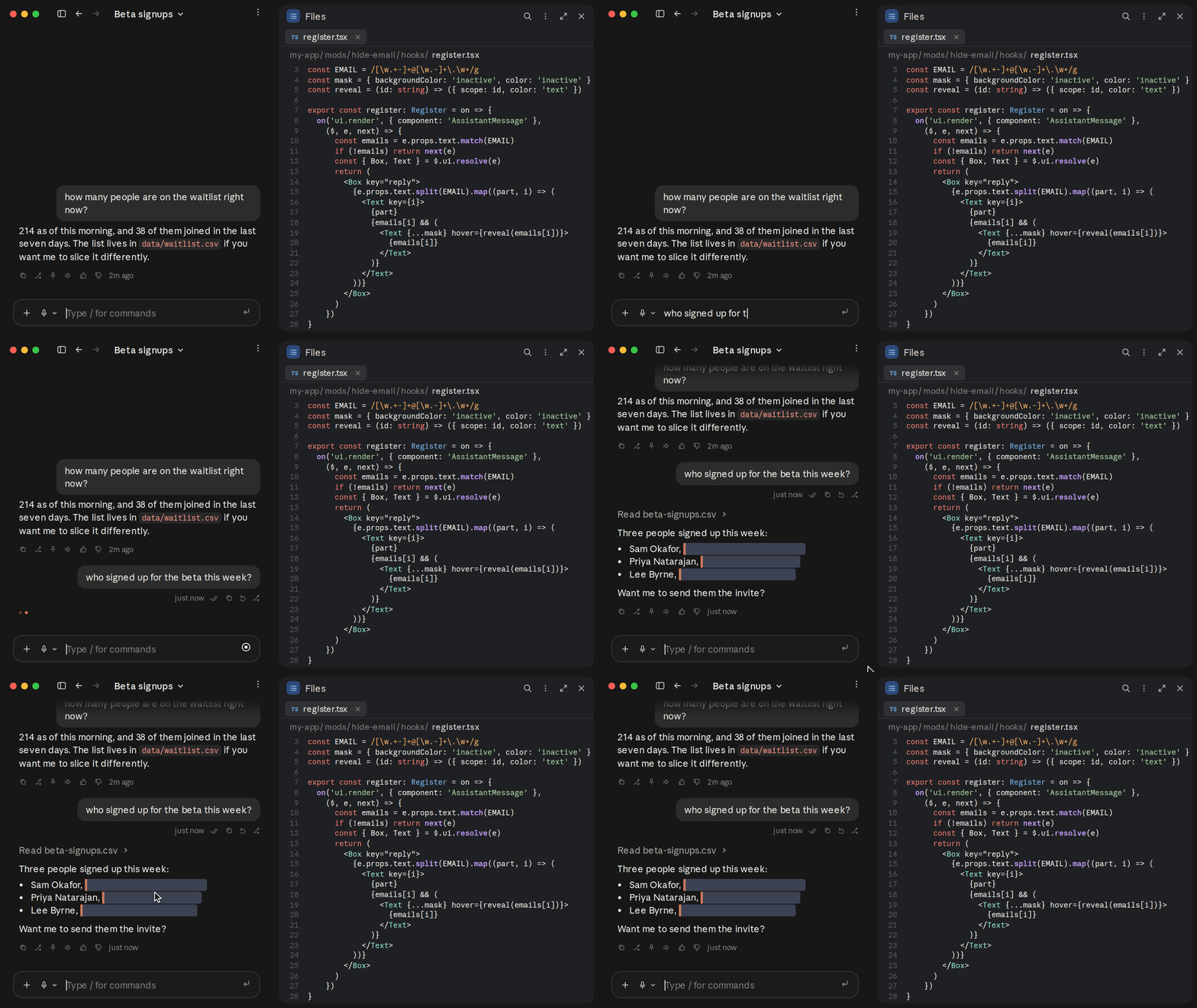
You can now mod Claude Code. A mod is a small TypeScript function in a plugin that hooks into Claude Code itself. It can hold or rewrite a tool call, draw UI, add a command, or replace a built-in feature entirely
Microsoft launched MAI-Transcribe-2-Streaming, delivering real-time transcripts in 60 languages. Transcribe-2 has come in at #1 in Artificial Analysis’s live transcription benchmark
Meta launches Muse for Small Business: handles background work across connected business apps while requiring approval before it publishes, sends, or spends
Meta’s Muse AI negotiated a sale on Marketplace, shared the seller’s pickup address, and told the buyer he was home, prompting an unexpected 9:15 p.m.visit
Instagram rolls out AI video assistant in Edits app, analyzing creator metrics and audience trends to surface actionable insights without doing the creative work
AI agent platform Manus launches 2.0 with Cascade harness (32% lower cost), Cloud hosting, Automations, Video Editor, & Game Dev
Amazon launched a refreshed Fire TV Stick 4K with a new remote featuring backlit buttons and improved ergonomics, & usability issues
Trump released a one-page AI accord signed by OpenAI, Google, Meta, Anthropic, Nvidia and X, asking for voluntary self-policing via internal controls and audits. Unfortunately, it misspelled the "United States" as "Unites States"
Shopify launches Canvas, an AI-powered site builder letting merchants create entire storefronts by chatting with Sidekick agent
GitHub Copilot computer use lets Copilot read your screen and click, type, scroll, drag, and operate desktop apps that do not expose an API
Airbnb is rolling out AI search via text or voice, smart filters, and AI-powered property comparisons. It’s also layering in more social discovery, with maps of where friends have stayed. Airbnb also continues to explore “hotel-like” territory with in-app services such as meal delivery, laundry, rentals, and neighborhood guides built from guest reviews
🤖 Futurism
Joby, the California eVTOL developer completed the first fully autonomous 3,199-mile cross-country flight with zero pilot inputs, supervised remotely
Tesla announced they’re hoping to produce 1,000 Optimus humanoids per week by EOY, a 10x increase from Q2 2026. This new push sounds impressive on paper, until you find out the extent to which they struggle with industry-related tasks
Paper-thin muscle-powered robot swims through watery mazes. MIT engineers built a biohybrid “aquabot.” The genetically engineered muscle cells flap like fins when hit by light, letting the aquabot slowly swim and steer through a maze. The team sees this as a path to tiny, efficient, self-healing robots for tasks like exploring fragile environments or future microscale operations
📚 Good reads
What is a moat in the age of AI? In a world where AI can clone products, interfaces, and even distribution in a few days, traditional moats like proprietary tech or switching costs are almost obsolete. The new defensible edge is how fast your organization can reinvent itself, and how much capital you can mobilize and recycle
Walking away from the wrong place. David Pereira shares how quitting a misaligned project, MBA, even after putting money and pride into it, became a turning point in his career. He encourages PMs to clarify what matters most to them, to distinguish between a tough but worthwhile challenge vs. the wrong place to be
Headless AI. As AI agents use your products through APIs or MCPs instead of screens, your “UX” becomes the contracts, semantics, and error messages they interact with. The article argues PMs need to treat logs as journey maps, map every door into the product, and design services and definitions
In a similar tone, Ben Thompson explains how AI agents with their own virtual computers will increasingly operate apps and websites on our behalf, turning traditional user interfaces into behind-the-scenes implementation details
Don’t postpone life; you will always be busy. Anne-Laure Le Cunff explains how we keep telling ourselves “next month will be calmer,” but our future selves won’t magically have more time or energy. We should treat chronic exhaustion as a system bug instead of a temporary issue. And we should plan as if our future weeks will be just as messy as this one. Prioritize the parts of life that keep you sane and make you happy
The new automation engineers. Aaron Levie explains how big companies are spinning up internal FDE-style roles that blend technical skills, AI expertise, and deep process knowledge to wire AI into workflows. There’s no playbook or ten-year veterans here yet, so it’s a greenfield career path
🎧 Good listen/watch
[Podcast + article] The Product job market is more intense than ever, but also full of opportunities for PMs who can build and lead. 3 exec recruiters share how founders are now looking for “executive builders”: senior Product leaders who still ship and bring technical depth. Founder experience helps, but it’s the traits that matter (high agency, judgment, clear ownership). In-person expectations (SF/NY) are also increasing
[Video Podcast] Testing Jev, Claude Opus 5.5, and GPT‑6 Sol. Claire Vo walks through how Jev, a cheap decision-focused model, lets her run classification and analysis jobs (like PRs and YouTube comments) at a ridiculously low cost. She also explains how she uses Opus 5.5 for frontend design and other tasks, and she compares it with GPT‑6 Sol
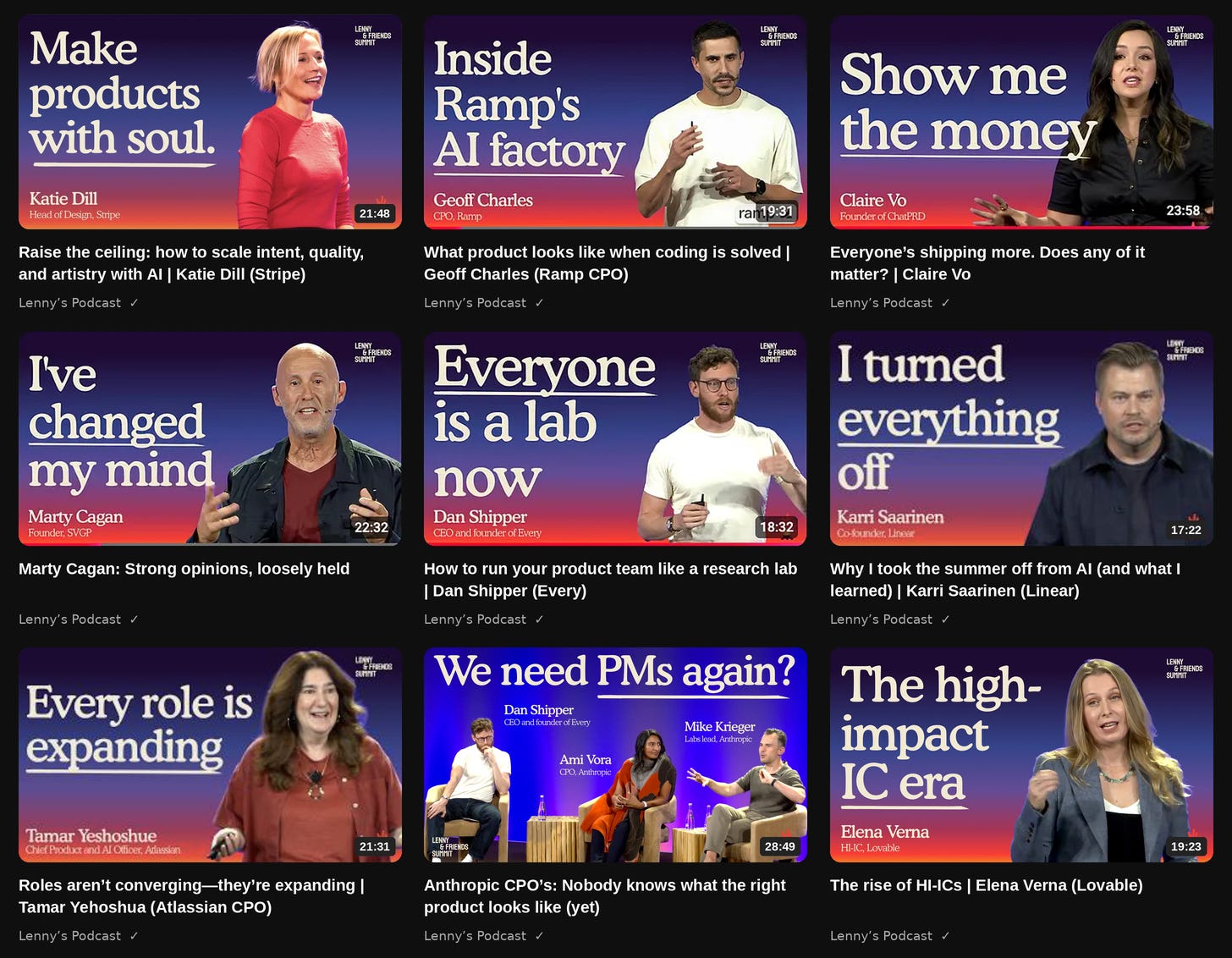
[Videos] Lenny & Friends Summit talks
🧑💻 Worth learning
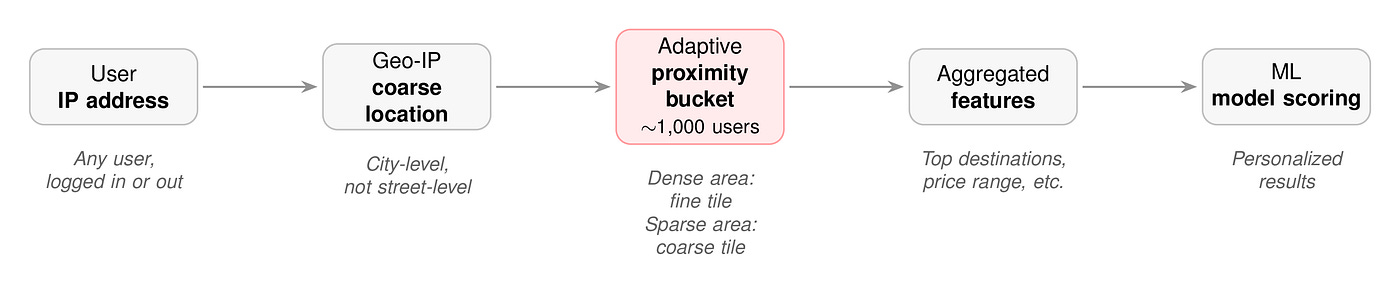
Personalization without user identity. An interesting piece by Airbnb for those of us working in personalization. A frequent problem for personalization is: how do you personalize for cold start (new) or for anonymous users? Airbnb explains how they group nearby users into proximity buckets based on coarse geo-IP, and build aggregate features (popular destinations, price ranges, booking patterns,…) from local users. This adaptive clustering works in dense and sparse regions, respects privacy constraints, and has already improved cold-start performance on a few of their products, like landing pages or autosuggest
🔧 Products to try
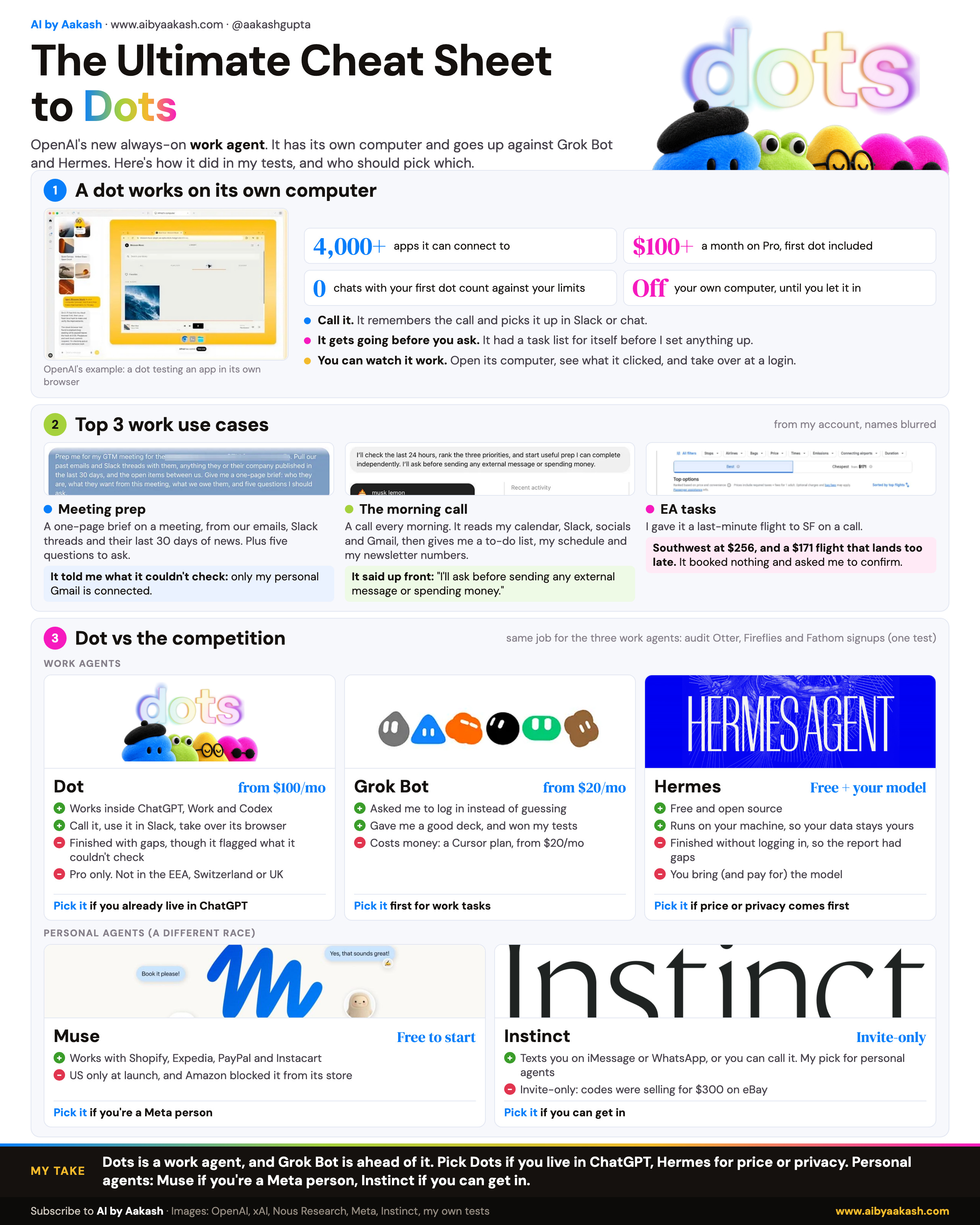
Dots: OpenAI’s GPT-6 Astra–powered agent, competing with free Muse for $20/mo
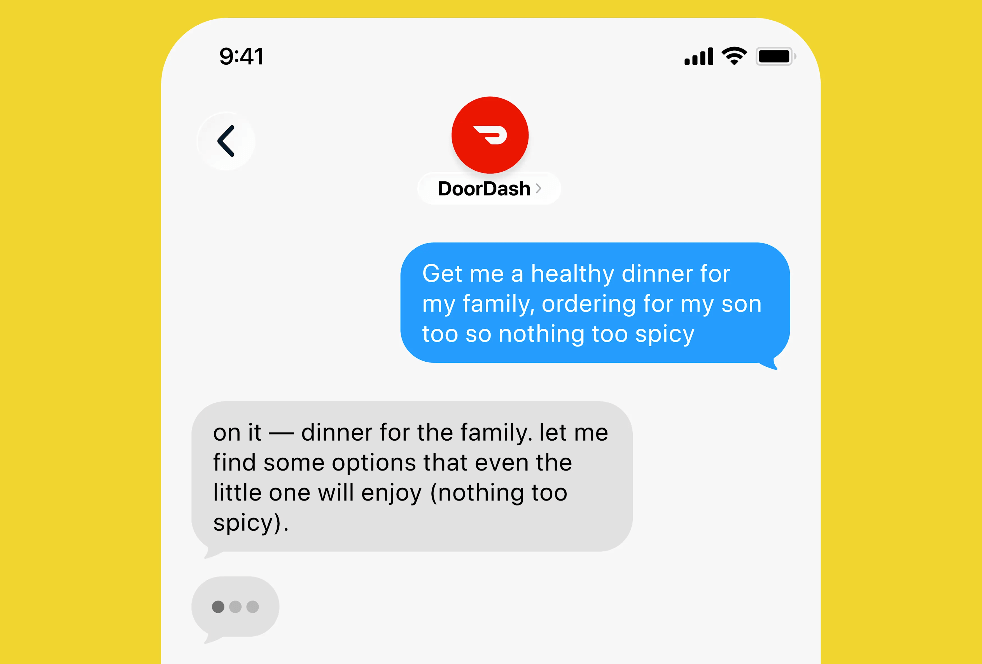
DoorDash SMS agent: AI text to order via Apple + DoorDash Air drones. US beta, waitlist open
AI regulation map: charts rules and practical tools for AI across major economies, including frameworks, standards, and resources like procurement templates. A helpful tool if you are looking to launch or develop AI products internationally
🤖 An experiment
Week in Product for your AI agent. More and more of the internet is being read by agents, so I've started publishing an agent-friendly edition of WiP: plain md, written to use as few tokens as possible. I’m hosting it at angeljaime.com/wip/latest.md. Your agent (Claude, ChatGPT, or a custom workflow) can read from it each week and have it brief you on what matters in tech and product. I'd love to know if you try it and what your agent does with it
That’s all for this week.
Feel free to drop your comments/questions/feedback. Would love to hear what you’d like to see more about in WiP, so I can make it better for you.
Have a great start to your week!